3D Secure 2
3DS (3-Domain Secure) is an online transaction authentication protocol launched by international card schemes and issuing banks to enhance the security of cardholder online payments. In recent years, with the proliferation of e-commerce and the shift from PCs to diverse mobile devices, credit card transaction security authentication mechanisms have also evolved. Under diversified e-commerce environments, international card organizations submitted the 3DS authentication mechanism to EMVCo to establish an industry standard. EMV officially released the 3DS 2.0 specification in October 2016, which has been adopted by major international card schemes including Visa, MasterCard, UnionPay, JCB, American Express, and Discover.

We recommend you to implement this protocol to comply with authentication regulations such as PSD2 SCA (Strong Customer Authentication requirements for online payments in the European Economic Area) and other identity verification regulations, while also benefiting from liability shift rules. Its advantages include:
- Risk transaction protection: Effectively reduces fraudulent transaction and chargeback rates through the 3DS authentication mechanism.
- Liability shift mechanism: For potential chargeback transactions, liability can be transferred to the issuing bank.
- Cross-platform support: Supports 3DS authentication processes on both PC and mobile devices.
- Diverse authentication methods: Supports multiple authentication modes such as challenge flow and frictionless flow, significantly improving 3DS authentication success rates.
Antom 3DS authentication solutions
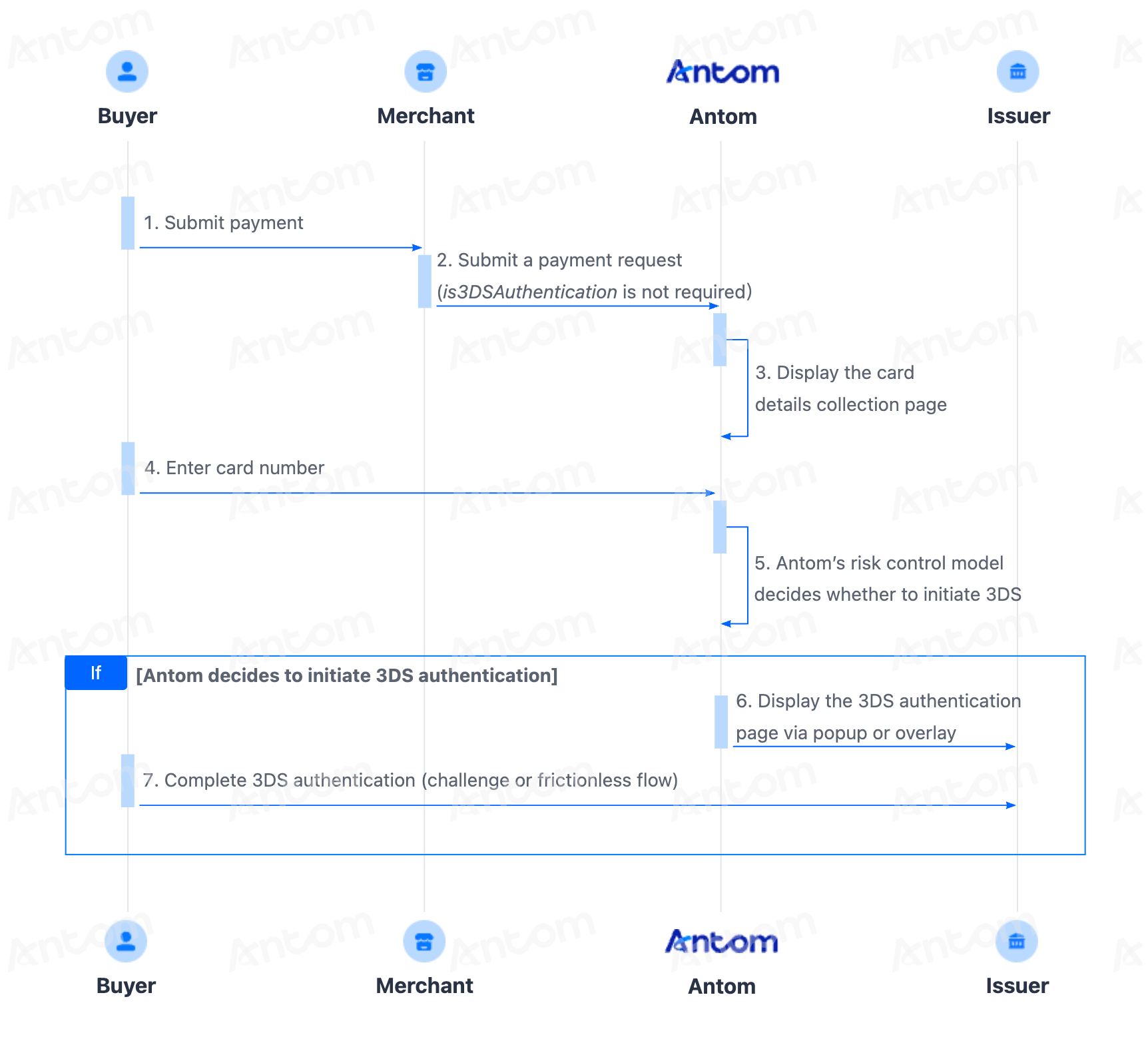
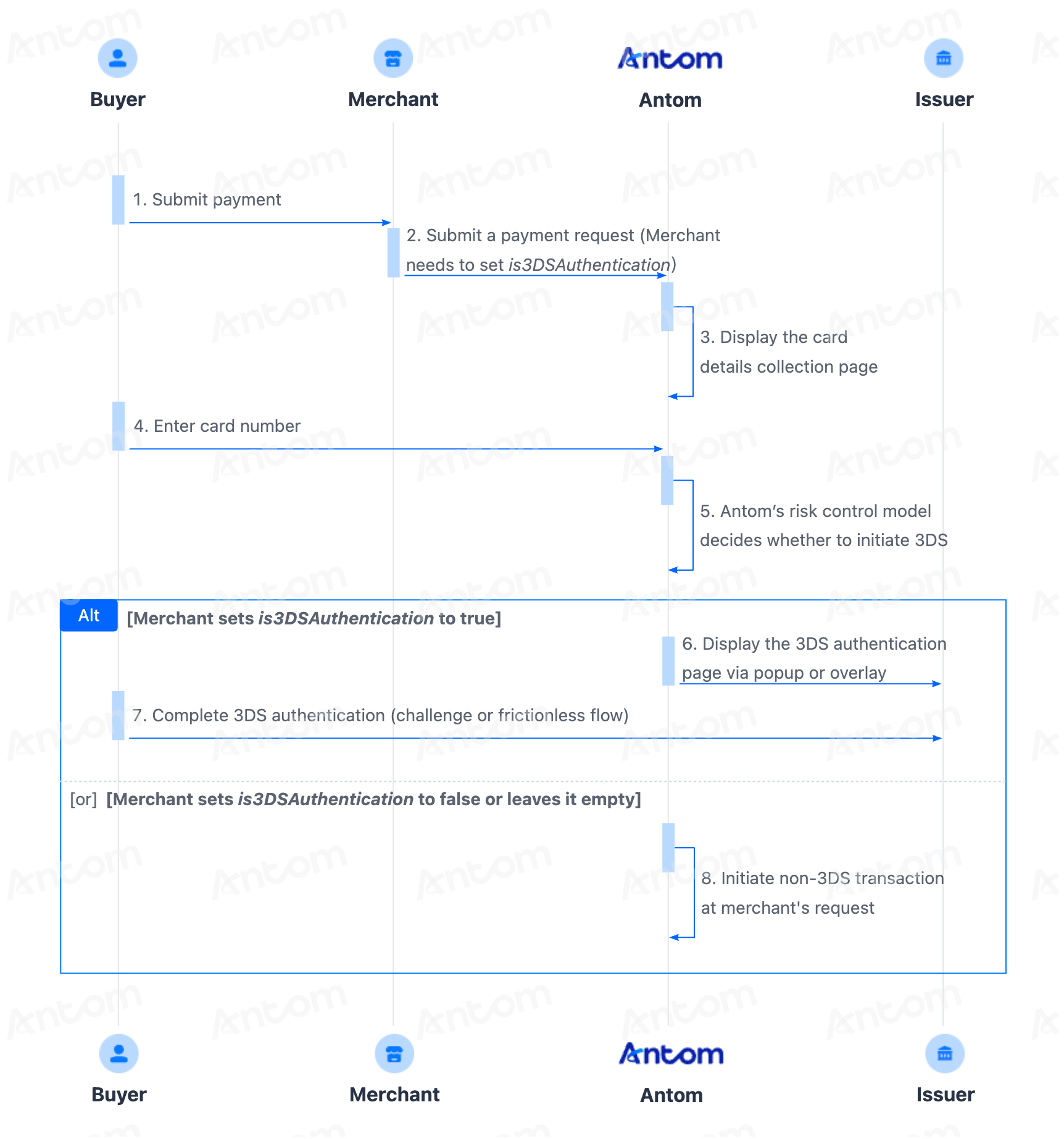
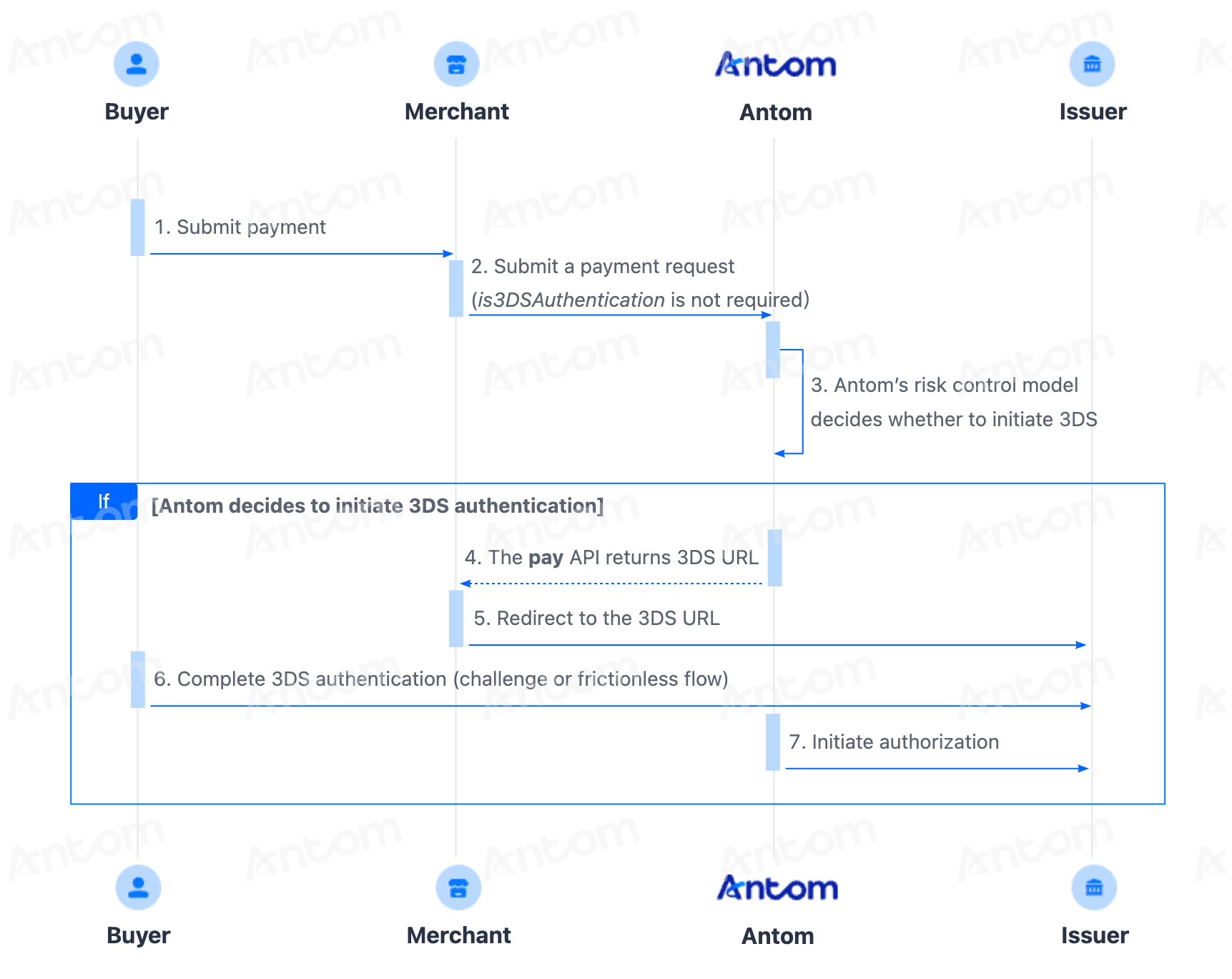
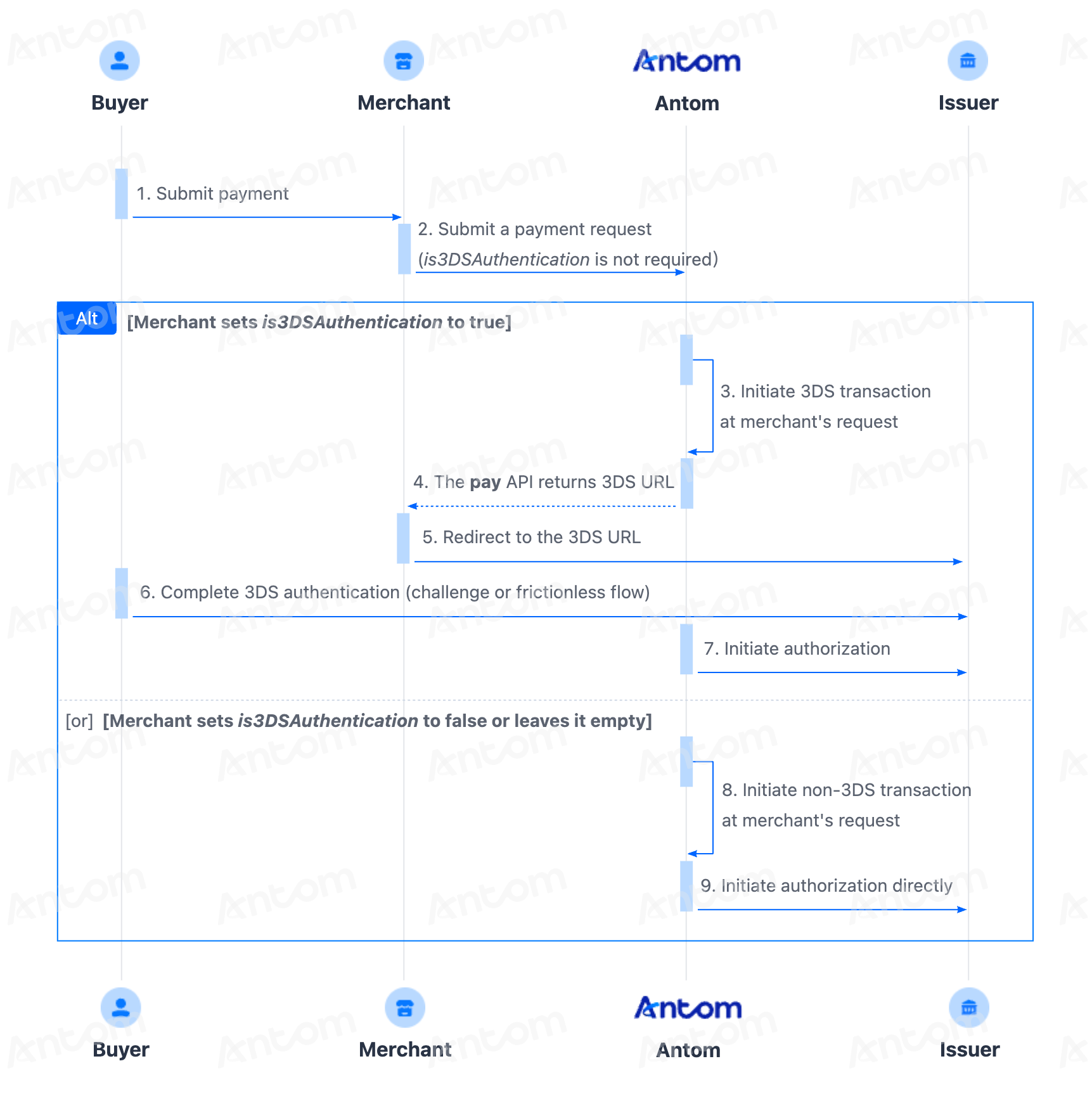
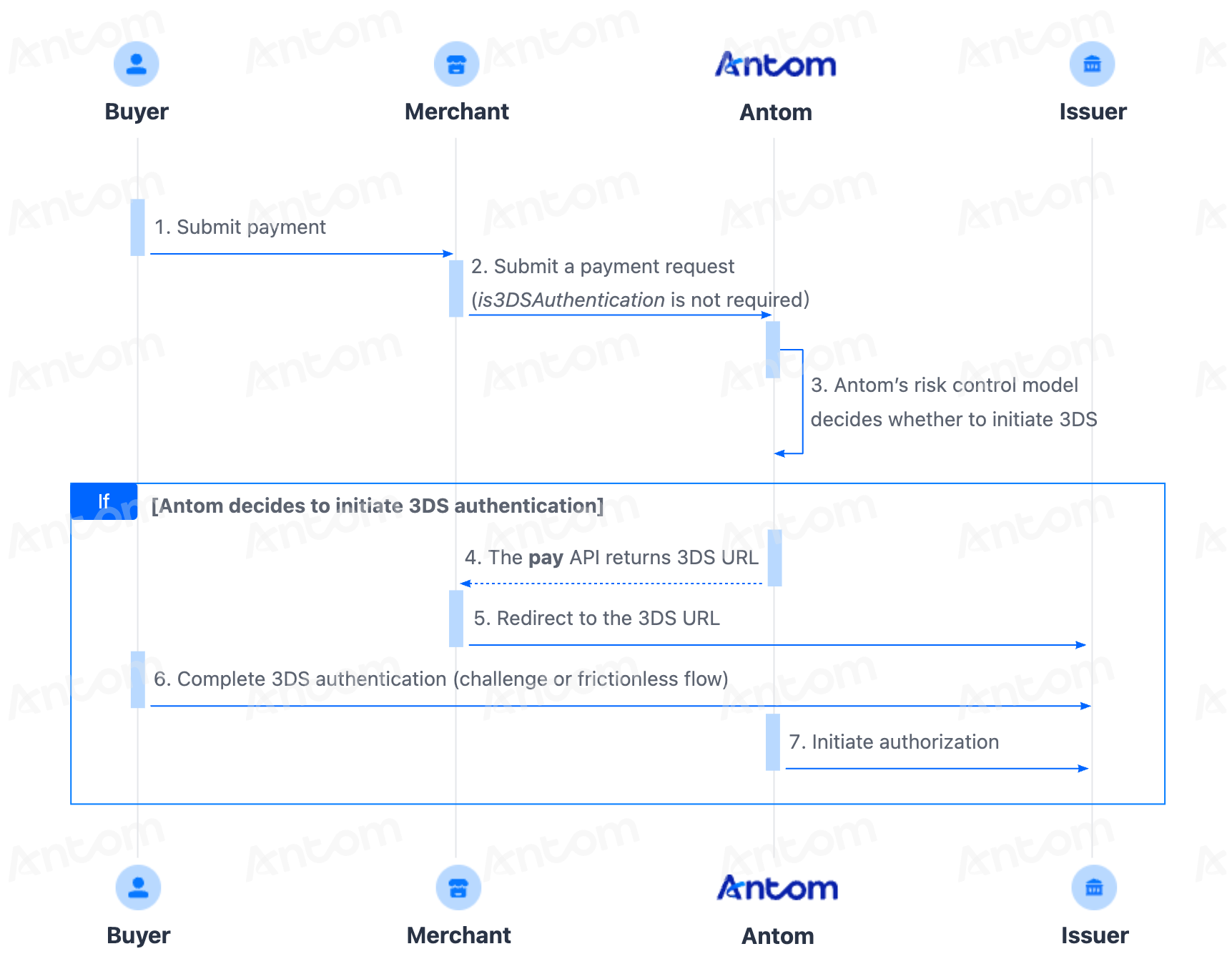
You can purchase Antom's risk control service to automatically determine whether to trigger 3DS authentication, or you can independently decide based on order risk, chargeback rates, and regional compliance requirements. Specific triggering logic is as follows:
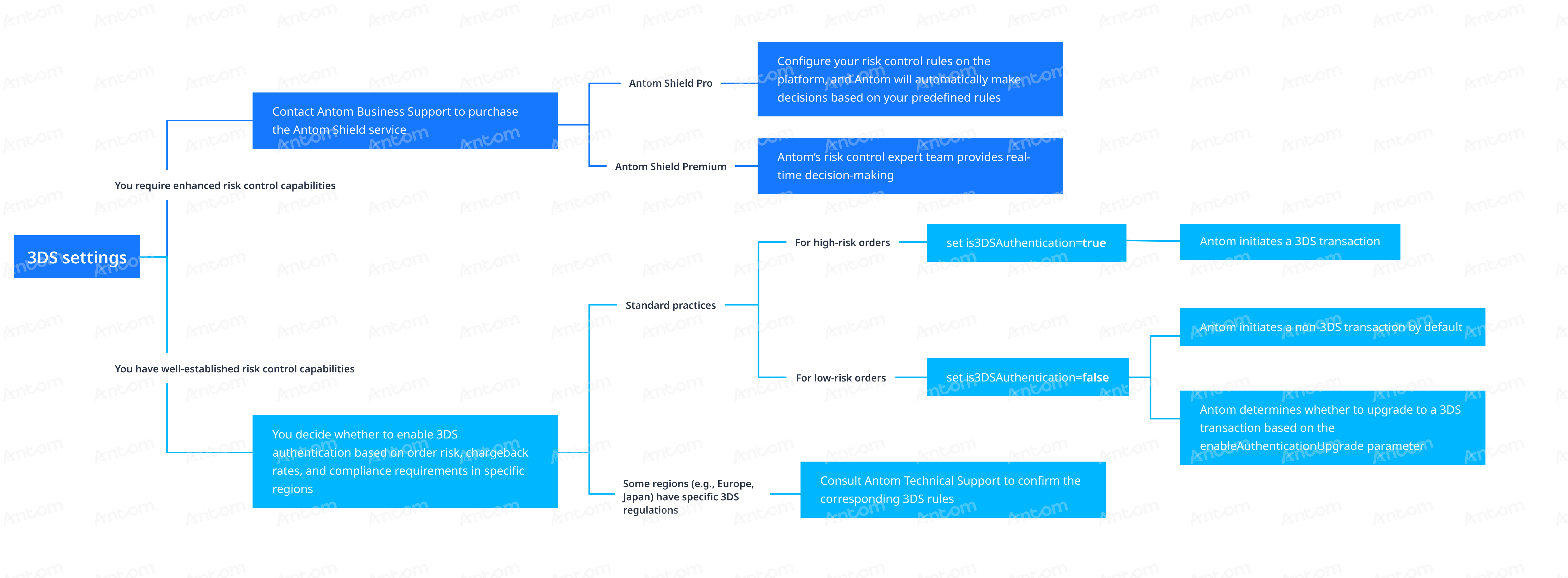
- If you have purchased the Antom Shield service, no manual parameter configuration is required. Antom will intelligently decide whether to initiate 3DS authentication for each transaction based on real-time risk assessment models, transaction characteristics, and historical data, aiming to strike an optimal balance between security and conversion rates. For more details, refer to Antom Shield.
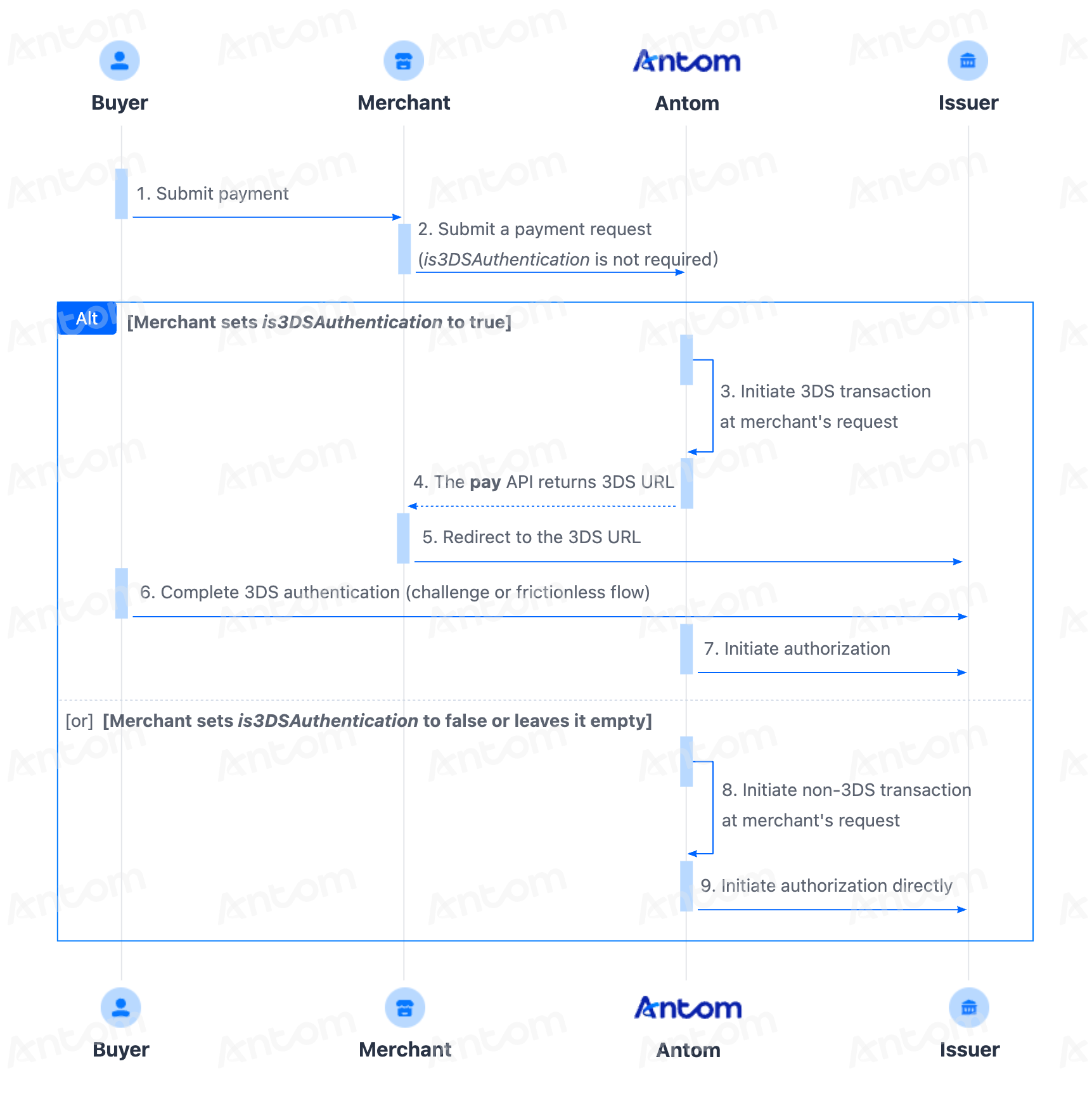
- If you have robust risk control capabilities, you can manually configure Antom’s 3DS authentication strategy based on transaction risk:
- For high-risk transactions, set is3DSAuthentication to true. Antom will always initiate 3DS transactions, and the value of the authenticationUpgrade parameter will be ignored.
- If you set is3DSAuthentication to false, Antom will prioritize non-3DS transactions. In this scenario, the value of authenticationUpgrade determines the subsequent process if the transaction is declined by the issuer:
- true: Default value. If the transaction is soft-declined due to authentication requirements, Antom will automatically upgrade it to a 3DS transaction and retry. For more information, see Antom 3DS-Retry.
- false: If the transaction fails, Antom will directly return the failure result without retrying.
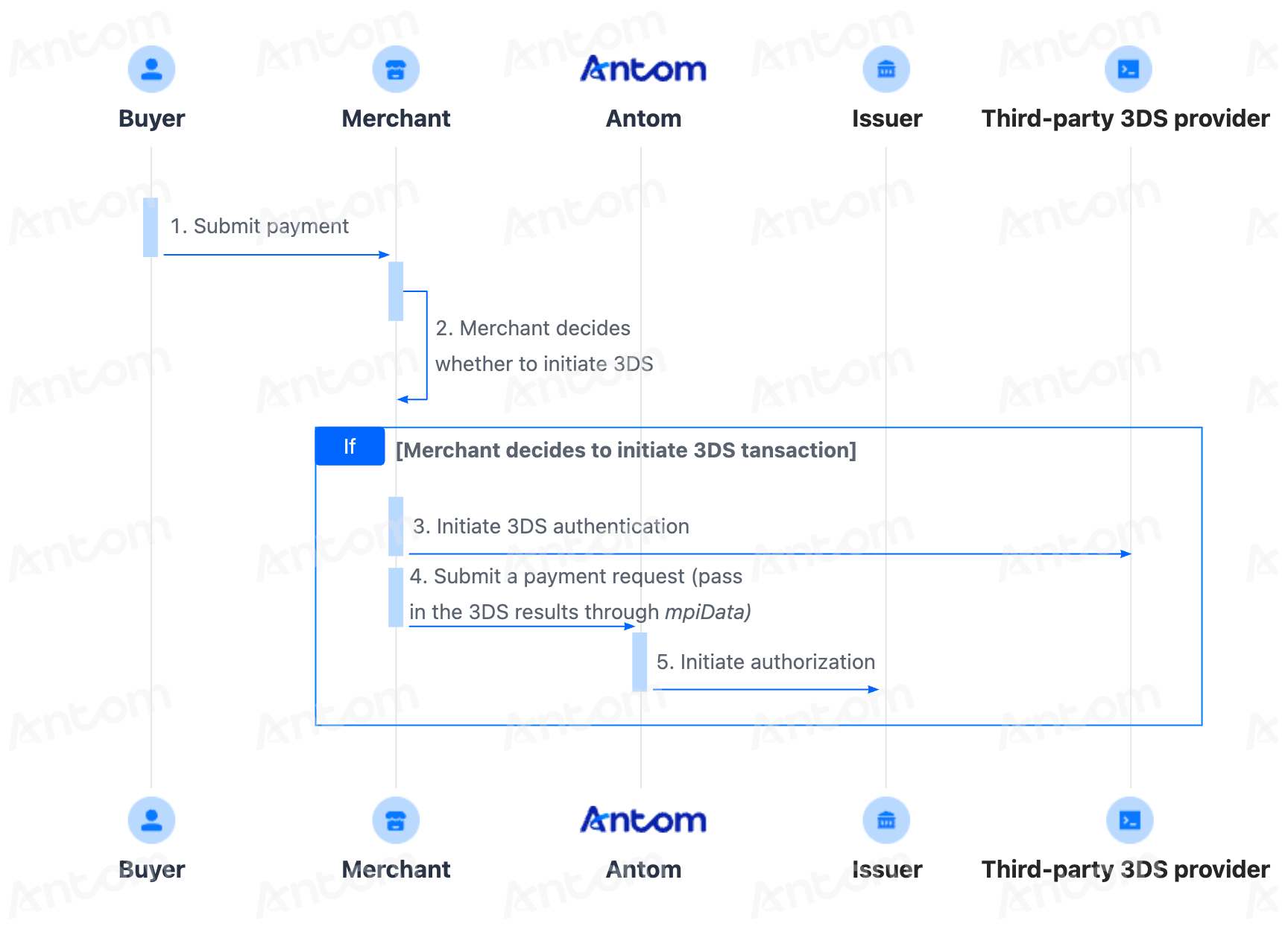
- If you use a third-party 3DS service, you must pass the 3DS authentication result to Antom for liability shift. Additionally, set both is3DSAuthentication and authenticationUpgrade to falseto disable Antom’s 3DS authentication. Currently, only server-to-server card integration supports the use of third-party 3DS services.
Common questions
Q: If I do not set the is3DSAuthentication parameter, will Antom decide whether to initiate a 3DS transaction on my behalf?
A: No. If the is3DSAuthentication parameter is not set, non-3DS transactions will be initiated by default, which may expose you to risks such as card fraud and chargebacks. Only after purchasing the Antom Shield service will Antom’s risk control model automatically determine whether to initiate 3DS authentication. In such cases, you do not need to set the is3DSAuthentication parameter.
The following table illustrates the 3DS modes supported by different integration options:
3DS mode/ Integration option | Payment Element integration | Checkout Page (CKP) integration | Hosted card integration | Server-to-server card integration | SDK integration |
Antom 3DS service & risk control | ✔️ | ✔️ | ✔️ | ✔️ | ✔️ |
Antom 3DS service only | ✔️ | ✔️ | ✔️ | ✔️ | ✔️ |
Third-party 3DS service | ❌ | ❌ | ❌ | ✔️ | ❌ |
User experience
3DS 2.0 authentication includes two modes: challenge flow and frictionless flow. Antom automatically determines the optimal mode based on risk level and the specific payment scenario. Below is the user experience for each mode:
Note: If you use a third-party 3DS service, no frontend page is involved. You must pass the 3DS authentication results obtained from the third-party provider to Antom though API.
Antom 3DS challenge flow | Antom 3DS frictionless flow |
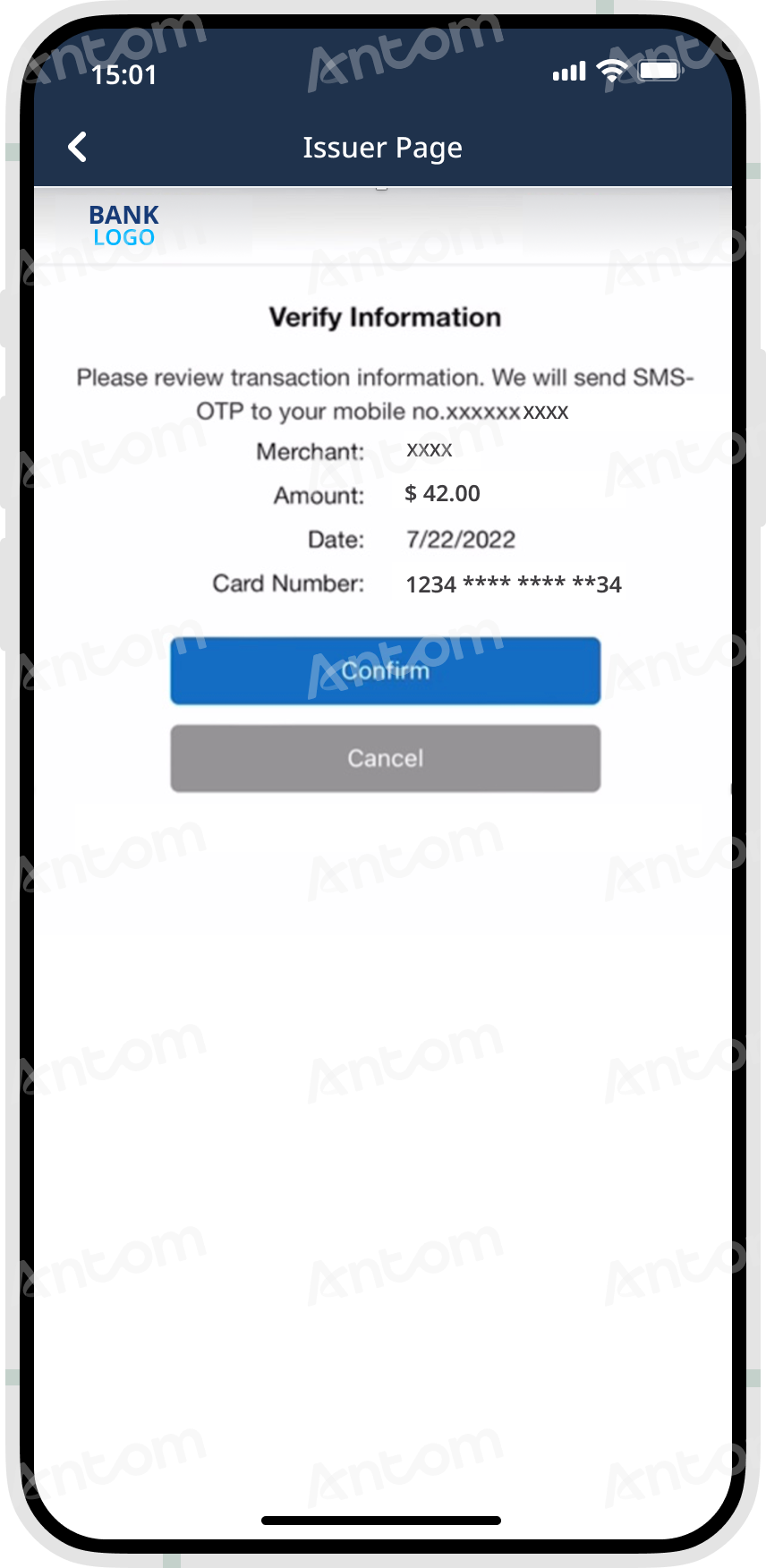 This mode requires redirecting to a 3DS URL and involves the buyer completing identity verification. | 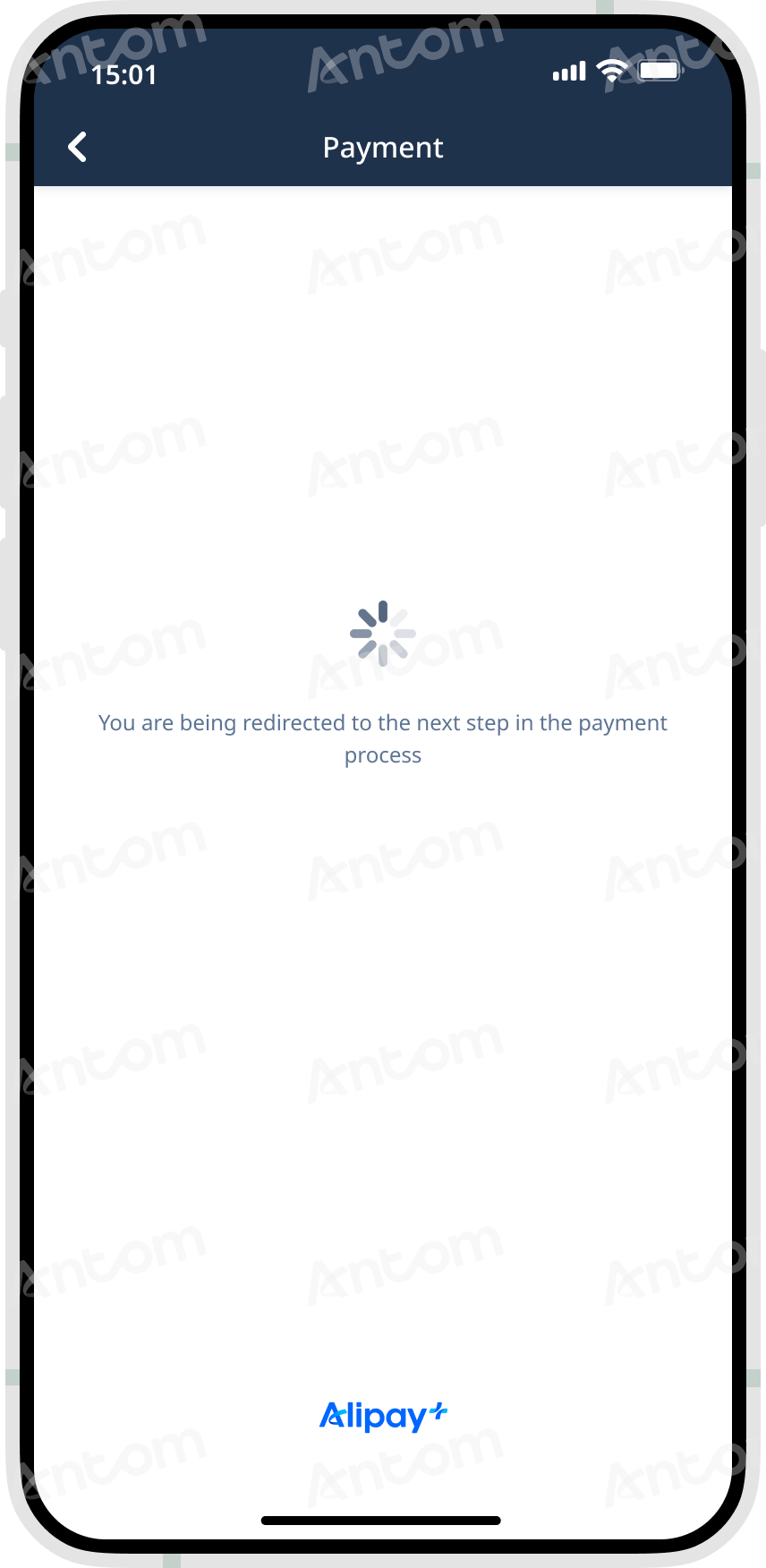 This mode requires redirecting to a 3DS URL only to collect environmental information, with no additional action required from the buyer. |
How to enable
Payment Element integration
Checkout Page integration
Hosted card integration
Server-to-server card integration
SDK integration